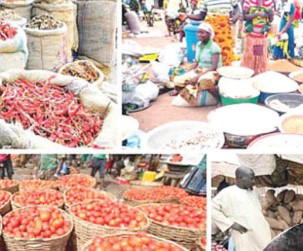
*Unsafe food kills 53,000 Nigerians annually, sickens 50m, FG raises alarm
By Sola Ogundipe, Health Editor, Babajide Komolafe & Joseph Erunke
LAGOS — Across many Nigerian homes, meals are changing quietly. Portions are smaller. Shopping is more careful. Families now measure food differently.
Meals that once fed a household comfortably are now stretched across the day. Rice, beans and soup are divided into smaller portions. Breakfast is often the easiest meal to skip as hardship bites harder.
The worsening cost-of-living crisis tightened its grip on Nigerian households in the first quarter of 2026 as fresh data on food prices showed another wave of increases in the cost of basic staples, deepening hardship across the country.
Meanwhile, the federal government has raised a red flag over the growing food safety crisis in Nigeria, revealing that unsafe food was responsible for nearly 50 million illnesses and more than 53,000 deaths annually, with children under five accounting for the overwhelming majority of the burden.
On the feeding crisis, a mother of four in Ikeja, Adebimpe Olatunji, said: “We manage, the children may take bread before school, then the proper meal comes later. Sometimes everybody skips breakfast.”
Patricia, another mother, said: “It is no longer about eating well, it is just making sure everybody eats something.”
Angela, a civil servant and single mother, described it differently, saying “you notice your salary more through what it cannot do anymore.”
Teachers are seeing the effects too. Tunde Lawal, who teaches in a public school in Lagos, said some pupils now come to class without food for break time.
“You can tell when a child has not eaten properly. Some struggle to pay attention,” he added.
Smaller purchases at the market
At Mile 12 market in Lagos, traders say people no longer buy the way they used to. “Everything is now small, small,” said Ope, a pepper seller. “Before, somebody buys a basket, now it may just be a handful.” Biola Idowu said bulk buying had become difficult. “I buy only what can last a few days now.”
The 2025 Consumer Price Index report from the National Bureau of Statistics, NBS, showed food inflation remained in double digits for most of the year, as prices of staples, including rice, beans, yam and maize, rose sharply across urban areas.
In Lagos markets, rice that sold for about N250 or N300 per kilogram in 2015 now sells for between N1,800 and N2,200. Beans moved from roughly N300 per kilogram to as much as N2,800. A crate of eggs that once cost below N1,000 now sells for up to N6,000 in some areas.
Those increases are changing shopping habits. At Oyingbo market, also in Lagos, grains trader, Iya Ade, said more customers now shopped daily because weekly buying had become difficult.
“People calculate every item before they buy. Nobody shops carelessly again,” added Taiwo, a fish seller.
Food prices have rewritten household budgets
Feeding a family in Lagos now costs far more than it did a decade ago. Vanguard findings showed that around 2015, a family of five could spend between N35,000 and N45,000 monthly on food and still manage regular meals.
By 2025, keeping that same routine may require between N200,000 and N300,000.
The jump has changed the way many households buy and prepare food. Families now shop in smaller quantities, cut back on protein, and plan meals more carefully to make supplies last through the week.
What disappears first from the plate
When money becomes tight, many families cut protein and fresh foods before they reduce the quantity of food itself. Meat becomes occasional, fish is reduced and soups are stretched further.
“To survive, you remove meat first,” said Onome David, a single mother earning a minimum wage. “Then fish, then you adjust every other thing.”
Community nutrition practitioner, Eunice Obi, said she sees the pattern often in low and middle income neighbourhoods.
“People depend more on starch now because they just want food that fills the stomach,” she added. A 2024 World Bank Nigeria Development Update warned that rising food prices were pushing more families toward cheap, filling meals with lower nutritional value.
The effects are rarely immediate. “When families switch mostly to cheaper staples, fruits, vegetables and protein reduce first,” said Dr. Shoba Suri, a nutrition researcher. “The body may still feel full, but important nutrients are missing.”
Children and pregnant women are among the most vulnerable. Carina Venter, a paediatric nutrition specialist at the University of Colorado, said poor diets might affect growth and brain development, even when children appeared to eat regularly.
A quieter form of
malnutrition
Poor feeding does not always announce itself immediately, sometimes it begins with constant tiredness and frequent illness.
The Nutrition Society of Nigeria has repeatedly raised concerns about the growing difficulty many families face in accessing nutritious food.
Prof. Salisu Abubakar, President of the society, said poor nutrition often developed quietly before visible health problems appeared.
Former president of the society, Prof. Ngozi Nnam, said eating enough food didn’t always mean eating well.
“A child may eat regularly and still suffer malnutrition if the meals lack variety,” she said.
Turning back to local foods
Nutritionists say healthy eating is still possible for many households, but now requires more planning and simpler choices.
Mrs. Amaka Nwaora, Managing Director of Kamary Nutrition Consult, said many Nigerians wrongly assume nutritious meals must be expensive.
“Local foods are still some of the best options. Beans, millet, sweet potatoes, ugwu, groundnuts and local vegetables are nutritious and often cheaper than processed foods,” she said, adding that planning meals ahead could also reduce waste.
“A shopping list helps people focus on what they actually need. Buying in bulk markets can save money too,” she said.
Home cooking, she added, stretches food further. “Leftover yam can become another meal the next day, instead of being wasted.”
For many Nigerians, the question is no longer whether food prices are high, that reality is already settled. Families are still trying to figure out how to eat properly while prices keep climbing.
Tubers, eggs, beans top fresh inflation surge; households groan under rising cost of survival
Meanwhile, NBS Food Price Watch from December 2025 to March 2026, indicated that tubers, eggs, legumes and fresh vegetables recorded some of the sharpest increases, further eroding the purchasing power of millions of families already battling high inflation and weak income growth.
The latest surge pushed the prices of staple foods beyond the reach of many low and middle-income earners, forcing households to cut consumption, substitute meals and reduce spending on nutrition.
Sweet potatoes emerged as the commodity with the highest increase during the period, rising by 10.03 per cent from N752.86 in December 2025 to N828.34 in March 2026.
Irish potatoes followed with a 7.45 per cent increase to N2,044.40 from N1,902.61.
The poultry segment also came under intense pressure as the average price of one agric egg rose by 6.44 per cent to N256.48, while the price of a crate climbed 3.38 per cent to N6,127.62.
Similarly, yam tubers, a major staple across the country, rose by 4.38 per cent to N2,144.70, with Delta State recording one of the highest average prices at N2,680.21.
The situation was not different in the legumes market, traditionally regarded as an affordable source of protein for low-income households.
White beans increased by 6.31 per cent to N1,276.63, while brown beans rose by 6.06 per cent to N1,325.85.
Imported long-grain rice also recorded an increase of 1.03 per cent to N2,223.83, while local short-grain rice rose by 1.70 per cent to N1,876.36.
Garri prices equally moved upward, with white garri rising by 3.24 per cent and yellow garri increasing by 2.20 per cent.
Fresh vegetables maintained an upward trajectory as tomatoes rose by 4.53 per cent to N1,104.95, while carrots gained 4.31 per cent to N2,003.08.
Other food items that recorded increases included ginger, bread, dairy products, beef and frozen fish.
However, a few commodities recorded marginal declines during the period.
Semovita dropped by 4.83 per cent to N2,160.42 from N2,270.15, while palm oil and groundnut oil recorded slight decreases of 1.32 per cent and 1.07 per cent respectively.
Reflecting the persistent increase in food prices, Nigeria’s annual inflation rate, which had declined for 12 consecutive months to 15.06 per cent in February, rose in March and April to 15.38 per cent and 15.69 per cent respectively.
Following the same trend, the annual food inflation rate rose to 14.32 per cent in March and 16.06 per cent in April.
Unsafe foods kill 53,000 Nigerians annually, sickens 50m, FG raises alarm
Consequently, the federal government yesterday raised alarm over the growing food safety crisis in the country, revealing that unsafe food was responsible for nearly 50 million illnesses and more than 53,000 deaths annually, with children under five accounting for the overwhelming majority of the burden.
Minister of State for Health and Social Welfare, Dr. Iziaq Salako, who raised the alarm at a ministerial briefing to commemorate the 2026 World Food Safety Day, themed “From Burden to Solutions – Safe Food Everywhere,” in Abuja yesterday, said the combined impact of illnesses and deaths translated into a straggering 4.26 million years of healthy life lost due to sickness, disability and premature death.
The latest data, based on updated estimates released by the World Health Organization ,WHO, paint a grim picture of the devastating human and economic toll of contaminated food in Nigeria, where millions continue to suffer from preventable illnesses linked to unsafe food consumption.
“Most of this burden falls heavily on children under five who account for more than 80 per cent of all foodborne disease burden in Nigeria,” Salako said.
He warned that the consequences extend beyond illness and mortality, affecting children’s cognitive development, physical growth and future productivity.
“In practical terms, the true cost of unsafe food in Nigeria is not only measured in sickness and death but also in the lost developmental potential of our children,” he added.
The minister identified diarrhoeal diseases caused by foodborne pathogens as the biggest contributor to the country’s food safety burden.
According to him, over 40 million diarrhoeal illnesses annually are linked to dangerous pathogens, such as Salmonella, E. coli, Campylobacter, Shigella and Rotavirus.
These infections, he said, remained major causes of hospitalisation, malnutrition and death among children.
He also raised concerns over growing chemical contamination risks, particularly exposure to lead, which is increasingly linked to contaminated grains, spices and water sources.
“Chemical hazards are emerging as a serious concern, with lead exposure responsible for tens of thousands of healthy lives lost to illness, disability or early death,” the minister stated.
Despite the grim statistics, Salako highlighted significant progress made by Nigeria in strengthening food safety systems.
He disclosed that Nigeria’s 2023 Joint External Evaluation, JEE, showed measurable improvements in food safety capacity, while the country’s 2025 State Party Annual Report, SPAR, score surpassed WHO targets for low- and middle-income countries.
According to him, Nigeria is now among the leading countries in Sub-Saharan Africa in detecting, reporting and responding to foodborne disease outbreaks.
The government, he said, had strengthened coordination through the National Food Safety Management Committee and implemented the National Integrated Guidelines for Foodborne Disease Surveillance and Response, providing a unified framework for outbreak investigation, laboratory confirmation, food recalls and risk communication.
Beyond food contamination, the federal government also announced an intensified push against unhealthy diets driving the rise in non-communicable diseases such as hypertension, diabetes, stroke, heart disease and obesity.
Salako revealed that Nigeria has developed national guidelines for sodium reduction, while the National Agency for Food and Drug Administration and Control, NAFDAC, has finalised draft regulations to limit sodium levels in processed foods.
He disclosed further that Nigeria was implementing trans-fat elimination regulations, making it one of the first countries in Africa to adopt WHO-recommended limits on industrial trans-fats.
”The government is also strengthening policies on sugar-sweetened beverages and developing front-of-pack food labeling systems to help consumers make healthier dietary choices,” the minister said.
In a goodwill message delivered on behalf of NAFDAC Director-General, Prof. Mojisola Adeyeye, the agency reaffirmed its commitment to reducing foodborne diseases through science-based regulation, surveillance and stronger food control systems.
Represented by Eva Edwards, Director of Food Safety and Applied Nutrition, NAFDAC stressed that food safety remained critical to public health, economic growth and national development.
“Food safety is not merely a technical issue, it is a public health, socioeconomic and development imperative,” the agency stated.
NAFDAC pledged to continue ensuring that foods manufactured, imported, exported and sold in Nigeria met acceptable standards of safety and quality.
In her welcome address, the Permanent Secretary of the Federal Ministry of Health and Social Welfare, Ms. Kachollom Daju, said food safety and healthy nutrition could no longer be treated as separate issues, warning that microbial contamination and poor dietary practices were combining to create a growing public health burden.
She stressed that recent national and global assessments have revealed a disturbing convergence between foodborne diseases and unhealthy diets, necessitating an integrated response involving government agencies, regulators, academia, industry and civil society.
“This year’s theme challenges us to move beyond understanding the problem and focus on practical, coordinated and sustainable solutions that will ensure every Nigerian has access to safe and healthy food,” Daju said.
Development partner, Resolve to Save Lives, RTSL, also pledged continued support for Nigeria’s efforts to improve food safety and healthy nutrition policies.
Representing RTSL Country Director, Mrs. Nanlop Ogbureke, Principal Advisor and Manager, Cardiovascular Health, Mrs. Okeoma Obasi, praised the federal ministry of health, WHO and stakeholders for advancing evidence-based policies aimed at reducing food-related diseases.
Delivering a goodwill message on behalf of the federal ministry of environment, government officials emphasised that food safety was a collective responsibility requiring action at every stage of the food chain.
The ministry identified poor sanitation, unsafe water, pollution, climate change, weak waste management systems and unsafe agricultural practices as major drivers of foodborne diseases in Nigeria.
“Food hygiene and safety is everyone’s business. By reducing foodborne diseases, we save lives, improve productivity and strengthen economic prosperity,” the ministry stated.
On its part, the World Health Organization, WHO, urged Nigeria to seize what it described as a historic opportunity to tackle foodborne diseases using newly available country-specific evidence.
According to the global health body, unsafe food remains a major but largely preventable cause of illness and death worldwide.
“Safe food is not a luxury, it is a fundamental human right and a cornerstone of health, nutrition and economic productivity,” the organisation said.
The Standards Organisation of Nigeria, SON, highlighted the critical role of standards in safeguarding consumers and strengthening confidence in the food system. The agency stressed that food safety standards provide a common framework for producers, processors and regulators to ensure quality assurance and compliance.
