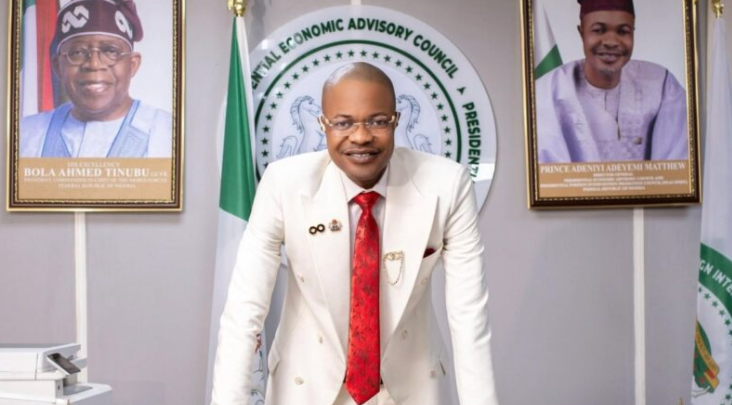
Director-General of the purported Presidential Foreign Intervention Promotion Council (PFIPC), Adeniyi Adeyemi, has claimed that the N400 million he allegedly paid to obtain his appointment letter was borrowed and that those who provided the funds have petitioned the Economic and Financial Crimes Commission (EFCC) to recover their money.
Adeyemi made the disclosure during an appearance on Channels Television’s Politics Today on Monday, weeks after accusing the Chief of Staff to President Bola Tinubu, Femi Gbajabiamila, of receiving the money through an intermediary to facilitate his appointment.
“I borrowed this money. In fact, those that I borrowed this money from have reported to the EFCC. I borrowed this money to pay for this appointment. They have written to the EFCC, asking me to refund their money.
“So, I’m not even here to pay the money back. I borrowed this money,” he said.
Describing the government’s response to the controversy as unfair, Adeyemi alleged that certain individuals within government had subjected him to public embarrassment.
“Imagine the government claiming I manoeuvre the whole system. It’s unfortunate,” he said.
Responding to reports that a United States lobbying firm was assisting him in pursuing asylum, Adeyemi said he had no direct knowledge of such efforts and only became aware of them through media reports.
“I read it the way you read it. Some people call me that they are looking for me,” he said.
He added that he had limited access to information surrounding the matter because his social media presence had been disrupted.
“I just ignore; because they sponsor a lot of people to bring my social media handle down. So, I don’t really know much what is going on again. I just hear from family and friends,” he said.
Adeyemi also dismissed suggestions that he intended to flee Nigeria, insisting he remained in the country despite reports claiming otherwise.
“They pulled my social media handle down, and they still reported that I was about to run away out of Nigeria. I’m still in Nigeria. I’m not going anywhere,” he said.
The controversy surrounding the PFIPC became public after the Presidency issued a disclaimer on June 11, signed by Gbajabiamila, stating that no such agency existed under the Tinubu administration and identifying Adeyemi as an impostor.
In a more detailed statement released on July 1, the President’s Special Adviser on Information and Strategy, Bayo Onanuga, said police investigations revealed that Adeyemi allegedly forged a presidential appointment letter purportedly signed by Gbajabiamila, operated a non-existent government agency and maintained 34 bank accounts, including nine allegedly opened in the names of fictitious government institutions.
The Presidency said suspicions first arose in October 2025 after the Nigerian Investment Promotion Commission reported that another organisation presenting itself as a government agency was carrying out overlapping functions.
Despite the official denial, Adeyemi has continued to insist that his appointment was legitimate, maintaining that he openly operated for nearly three years, interacted with heads of ministries, departments and agencies, and hosted delegations from institutions including the EFCC and the Ministry of Foreign Affairs.
He has also alleged that Gbajabiamila collected N400 million through a proxy to facilitate his appointment, later demanded an additional N200 million and sought 48 per cent of a purported N27.4 billion take-off grant for the council. Gbajabiamila’s legal team has denied the allegations, describing them as false and threatening a N10 billion defamation lawsuit.
However, Adeyemi later told activist Martins Otse, popularly known as VeryDarkMan, that he had never met Gbajabiamila physically and could not verify the identity of the person he allegedly communicated with over the phone.
The controversy deepened after the council appeared in the 2026 Appropriation Act with an allocation of more than N1.3 billion, raising fresh questions over how an agency described as fictitious was included in the national budget.
President Bola Tinubu has since directed the Independent Corrupt Practices and Other Related Offences Commission (ICPC) to investigate the matter and submit its findings within 30 days.