By Omeiza Ajayi
ABUJA — President Bola Ahmed Tinubu is entering the 2027 presidential race as the clear frontrunner, not necessarily because of widespread popularity, but because his opponents remain divided, according to a new forecast by political consulting and data analysis firm CellHub.
The firm projects the president as the favourite to secure a second term, arguing that its assessment is based less on his approval ratings — currently estimated in the low 30 per cent range — and more on the fractured state of the opposition and Nigeria’s winner-takes-all electoral system.
According to CellHub, Nigeria’s electoral framework, which awards victory to the candidate with the highest number of valid votes rather than an outright majority, gives a significant advantage to a united ruling party facing a fragmented opposition.
The firm pointed to the 2023 presidential election as an example. Tinubu won with 36.61 per cent of valid votes, while Atiku Abubakar secured 29.07 per cent, Peter Obi garnered 25.40 per cent, and Rabiu Musa Kwankwaso received 6.23 per cent.
Although more than 60 per cent of valid votes were cast for candidates other than the winner, the opposition’s division enabled Tinubu to emerge victorious with a comfortable lead.
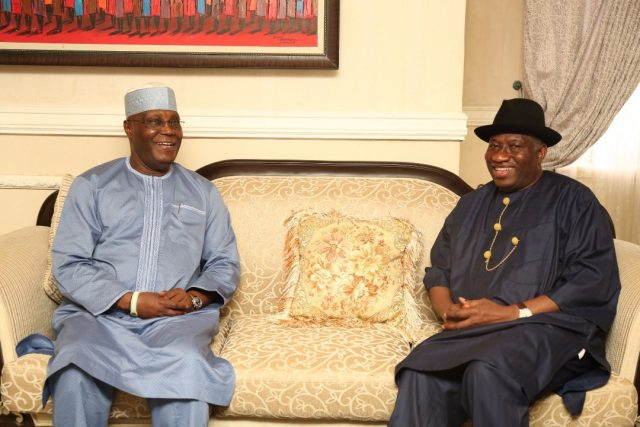
CellHub noted that a similar pattern has emerged ahead of the 2027 election. Atiku is running on the African Democratic Congress (ADC) ticket alongside Rotimi Amaechi, while Obi and Kwankwaso were ratified as candidates of the Nigeria Democratic Congress (NDC) on May 30. A faction of the Peoples Democratic Party (PDP) has also advanced Goodluck Jonathan, though the nomination remains contested within the party.
With three opposition candidates targeting the anti-incumbent vote, CellHub believes the political landscape strongly favours the president.
Tinubu’s position, the report added, has been strengthened by a wave of defections that has left the All Progressives Congress (APC) in control of 31 of Nigeria’s 36 states and holding a two-thirds majority in the National Assembly. The party formally confirmed him as its presidential candidate on May 23.
The firm also highlighted historical trends, noting that among Nigeria’s elected presidents, only Jonathan failed to win re-election. His 2015 defeat came against a united opposition coalition, a strategy the current opposition has yet to adopt.
“Our modelling is not a statement about who deserves to win, or about how people feel, both of which point in a hard direction for the incumbent,” said Mohammed Aliyu, Managing Partner and Lead Data Scientist at CellHub.
“It is a statement about distribution. A unified bloc beats a divided one almost regardless of mood. Right now the opposition is divided and the governing party is not.”
CellHub acknowledged that many Nigerians report being worse off economically than they were in 2023. However, it argued that such sentiment would pose a more serious threat to the president only in a direct one-on-one contest.
The firm also challenged perceptions of Obi’s electoral strength, arguing that his substantial online following does not necessarily translate into votes. According to the report, social media audiences are disproportionately young, urban and connected, while rural northern voters — who historically account for higher turnout levels — remain underrepresented online.
CellHub said its projections are based on voting intentions and turnout probabilities across geopolitical zones rather than digital engagement metrics.
The report further suggested that the administration’s defence of key economic reforms, including fuel subsidy removal and the floating of the naira, is beginning to resonate with a growing segment of voters.
While macroeconomic indicators such as growth, foreign reserves and inflation have shown some improvement, CellHub acknowledged that household incomes and poverty levels have worsened. Nevertheless, it believes more voters are accepting the government’s argument that the reforms helped avert a deeper economic crisis.
Geographically, the firm identified the North-Central region and the broader Middle Belt as the likely battleground for the 2027 election.
“The South-West is largely decided, and the South-East in the other direction,” said Efemena Peter, Senior Political Risk Analyst at CellHub.
“The result is set in the North Central and the FCT. Those states moved against the President in 2023, and they are the states we watch most closely for 2027. Whoever carries the Middle Belt carries the election.”
However, CellHub said a merger between the Atiku and Obi camps could dramatically alter the political equation by creating a direct two-way contest between the opposition and the incumbent.
Such a development, it noted, would shift the election from a contest shaped by vote distribution to one focused squarely on the president’s record in office, making the outcome far less predictable.
Until then, the firm maintains that the arithmetic of a divided opposition continues to favour the incumbent.
CellHub said it would update its projections should any opposition consolidation occur and plans to release revised electoral scenarios quarterly ahead of the polls scheduled for January 16, 2027.