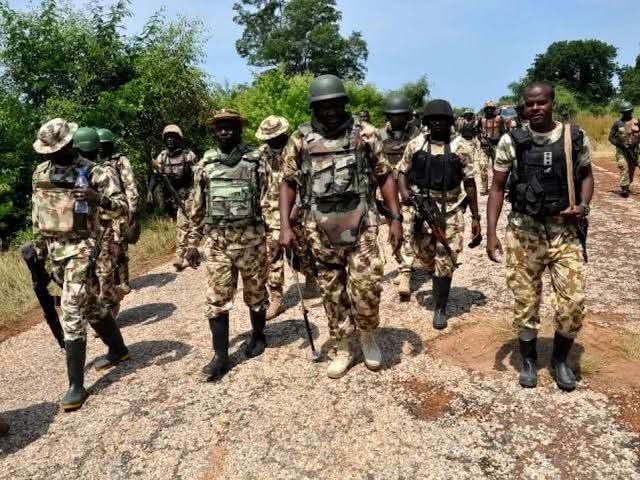
…Three mid-level commanders among those eliminated
By Kingsley Omonobi
ABUJA — The growing security partnership between Nigeria and the United States Africa Command (AFRICOM) has recorded another major success following the elimination of 21 fighters of the Islamic State West Africa Province (ISWAP) in a precision strike carried out in Arege, Borno State.
Security sources disclosed that three of the terrorists killed during the operation were mid-level commanders believed to have coordinated several attacks and raids in Monguno, Damasak and surrounding communities in northern Borno State.
The operation, which was jointly coordinated by the Nigerian Air Force and the United States Africa Command, was based on actionable intelligence indicating that a group of terrorists had gathered in the area to plan attacks against military and civilian targets.
A member of the Minister of Defence Media Team and specialist in Military Public Information and Counterterrorism, retired Colonel Timothy Antigha, confirmed the operation, describing it as another significant outcome of the evolving defence cooperation between Nigeria and the United States.
According to him, the strike demonstrates how the bilateral security relationship has progressed beyond conventional military training and equipment support to real-time intelligence-driven operations against terrorist networks.
Antigha said intelligence, surveillance and reconnaissance assets detected unusual terrorist activity in Arege, a strategic community located along a major ISWAP logistics corridor linking Nigeria, Niger and Chad.
He explained that intelligence reports indicated that armed terrorists were assembling in the area for possible attacks, prompting immediate coordination between Nigerian forces and allied partners.
“Intelligence Surveillance and Reconnaissance assets observed that terrorists were assembling in Arege for possible attacks on targets within the locality. Consequently, operational coordination with friendly forces was activated.
“The intelligence gathered was fused with US AFRICOM satellite imagery and signals intelligence. Once a cluster of 21 armed terrorists was confirmed in a concealed staging area, a joint strike was authorized,” he said.
According to Antigha, all 21 identified terrorists were successfully neutralized during the operation, with no civilian casualties reported.
He noted that the absence of collateral damage underscored the increasing effectiveness of intelligence gathering, targeting procedures and operational coordination between both countries.
“That precision matters. It reflects improved targeting, better coordination and reduced collateral damage — the exact outcomes the partnership was redesigned to achieve,” he stated.
Strategic Importance of Arege
Providing further insight into the significance of the operation, Antigha said Arege occupies a critical position within ISWAP’s operational architecture.
He explained that the area serves as a major transit point for the movement of fuel, food supplies, weapons and ammunition destined for terrorist cells operating within the Sambisa Forest and Mandara Mountain corridors.
Beyond logistics, he said the community has also functioned as a recruitment hub where young people are often lured or coerced into joining terrorist ranks.
The retired military officer further identified Arege as one of the command-and-control locations used by ISWAP elements to coordinate operations across the Lake Chad region.
“By degrading ISWAP capabilities in Arege, Nigerian forces have reduced the group’s ability to launch attacks on military formations and civilian communities in northern Borno.
“The operation also sends a strong message that border areas previously considered safe havens for terrorists are no longer beyond the reach of security forces,” he added.
Shift From Training to Intelligence-Led Operations
Antigha noted that the latest strike reflects a broader shift in Nigeria-US security cooperation since President Bola Tinubu assumed office in May 2023.
According to him, previous cooperation largely focused on military training programmes, equipment donations and general intelligence sharing.
However, the partnership has increasingly evolved into operational collaboration involving intelligence fusion, precision targeting and the disruption of terrorist leadership structures.
“For years, US-Nigeria security cooperation focused mainly on capacity building through training, equipment support and intelligence sharing.
“Since President Bola Tinubu assumed office, the partnership has entered a more operational phase, with emphasis on real-time intelligence fusion, precision strikes and targeting of high-value terrorist commanders,” he said.
Precision Rather Than Volume
Responding to criticisms in some quarters regarding foreign involvement in Nigeria’s counterterrorism efforts, Antigha argued that the effectiveness of military operations should be measured by accuracy rather than the volume of strikes conducted.
He explained that recent operational data suggest significant improvements in strike precision by Nigerian forces.
“The Nigeria-AFRICOM model is not about the quantity of strikes but the precision of those strikes.
“In 2022, Nigeria recorded more than 400 airstrikes with a reported precision rate of about 41 per cent. By 2024, the number of strikes had reduced, but precision reportedly increased to 67 per cent.
“The Arege operation fits into this pattern — fewer bombs, greater accuracy and better intelligence,” he said.
According to him, the ultimate objective remains the degradation of terrorist leadership structures, disruption of supply chains and the creation of conditions that encourage defections and surrender.
He noted that since 2023, more than 104,000 former Boko Haram fighters and their dependants have reportedly surrendered under Operation Safe Corridor, with many citing sustained military pressure and the elimination of key commanders as reasons for abandoning insurgency.
Intelligence as the Real Force Multiplier
Antigha stressed that the most significant benefit of the Nigeria-US security partnership lies in intelligence sharing.
He explained that US surveillance capabilities, including drones, satellites and signals intelligence systems, provide extensive coverage of difficult terrains that cannot be constantly monitored by ground forces.
At the same time, he said Nigerian security agencies contribute valuable human intelligence and local knowledge that help interpret and validate information gathered through technological means.
“The real yield of the AFRICOM partnership is intelligence.
“US surveillance assets cover terrain that Nigerian forces cannot monitor round the clock, while Nigerian human intelligence provides the local context that satellite imagery alone cannot deliver.
“The resulting operational synergy creates a formidable counterterrorism capability,” he said.
He added that under the revised 2024 Nigeria-US security cooperation framework, intelligence processing and operational decision-making timelines have been significantly shortened.
According to him, the reduced interval between target identification and strike authorization has improved operational effectiveness and increased pressure on terrorist groups.
“The speed achieved saves lives. Faster strikes mean fewer opportunities for terrorists to disperse, relocate hostages or emplace improvised explosive devices.
“It also increases psychological pressure on ISWAP fighters, who can no longer assume that darkness, distance or remote locations will guarantee their safety,” Antigha said.
Security analysts believe the latest operation represents another significant setback for ISWAP’s operational network in the Lake Chad Basin and highlights the growing role of intelligence-led warfare in Nigeria’s counterinsurgency campaign.