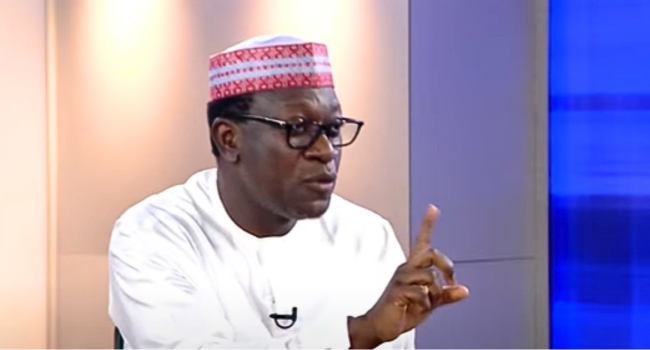
Former Edo State governor and chairman of the Senate Committee on Interior, Senator Adams Oshiomhole, has advocated a review of the Nigeria Security and Civil Defence Corps (NSCDC) Act and the provision of more sophisticated weapons for its operatives to effectively confront heavily armed criminals threatening national security.
Oshiomhole made the call in Abuja yesterday at the public presentation of a book; ‘Nigeria’s Security Dilemma: Rivalries and Implications’ written by the FCT commandant of the NSCDC, Dr. Olusola Odumosu.
He said the security realities confronting the corps had outgrown the limitations implied by its current designation as a civil defence organisation.
He acknowledged that NSCDC personnel are increasingly deployed against criminals involved in oil theft, vandalism of critical national assets, kidnapping and other violent crimes, many of whom possess advanced weaponry.
“If the criminals you have to fight carry sophisticated weapons, those confronting them should not be less equipped,” he said.
The senator maintained that the word “civil” suggests an unarmed outfit, a description he said no longer reflects the nature of operations undertaken by the corps.
Beyond improved armament, Oshiomhole stressed the need for stronger collaboration among security agencies, warning that inter-agency rivalry continued to weaken Nigeria’s response to insecurity.
He said the country’s security challenges had become increasingly complex and can no longer be addressed by any single agency acting alone.
“The issues are far more complicated than many people imagine. No one security agency can effectively tackle the challenges on its own,” he said.
The lawmaker identified poor intelligence sharing, lack of trust among security institutions and unhealthy competition for operational recognition as major obstacles to effective security management.
He called for closer cooperation among the DSS, police, military and other security agencies, insisting that intelligence gathering and intelligence sharing must become a routine part of security operations
The senate committee chairman expressed concern that some gains recorded by security agencies were often lost during prosecution, lamenting situations where suspects arrested after painstaking investigations were granted bail or discharged.
Minister of Defence, General Christopher Musa, said efforts were already underway to strengthen synergy among security agencies in response to emerging threats. He noted that he had reviewed the manuscript of the book and acknowledged its focus on inter-agency rivalry as a major challenge in Nigeria’s security architecture.
The minister emphasised that national stability must always take priority over institutional pride, adding that ongoing reforms are aimed at improving coordination and operational effectiveness across all security institutions.
The author of the book, Dr. Olusola Odumosu, Commandant of the NSCDC in the Federal Capital Territory (FCT), said the motivation behind the publication was to promote a united front among security agencies in tackling insecurity. He noted that no single agency possesses all the required capacity to effectively address Nigeria’s complex security challenges, adding that collaboration, not competition, should define inter-agency relations.
Odumosu stressed that intelligence sharing remains critical to defeating criminal networks, lamenting that rivalry among agencies has often undermined national security efforts.
In his review of the book, Professor Tyoor Ternhemba described Nigeria’s security situation as an “asymmetric war” requiring collective action from all security stakeholders. He warned that inter-agency rivalry and poor intelligence sharing have led to avoidable loss of lives and operational setbacks.
The reviewer called for sustained cooperation among the Army, Police, NSCDC and other agencies, stressing that the fight against insecurity must transcend institutional interests if meaningful progress is to be achieved.