By Enitan Abdultawab
A powerful 7.8-magnitude earthquake struck the southern Philippines on Monday, killing at least 12 people, injuring more than 200 others and triggering tsunami waves along parts of the country’s coastline.
The offshore earthquake struck at about 7:37 a.m. local time, with its epicentre located southwest of Maasim town in Sarangani province at a depth of approximately 33 kilometres, according to the Philippine Institute of Volcanology and Seismology.
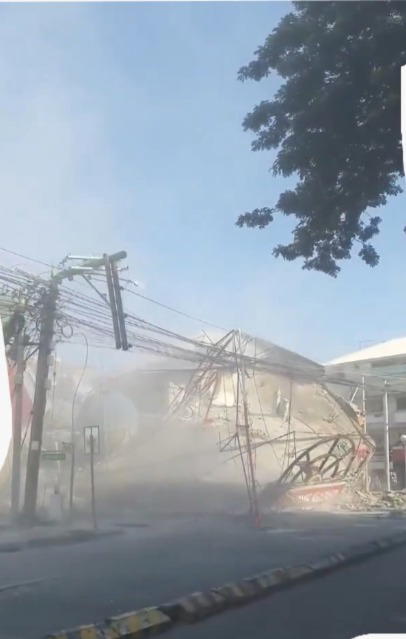
Authorities said the quake caused significant damage across parts of Mindanao, particularly in General Santos City, a major commercial hub and one of the country’s busiest tuna-export centres.
At least seven people died in General Santos, where several buildings partially collapsed and critical infrastructure, including a major access bridge, suffered extensive cracks. More than 130 people were injured in the city alone.
Five additional fatalities were recorded in South Cotabato, Davao Occidental and Balut Island, bringing the death toll to 12.
“It’s a major earthquake, and we’re expecting damage, and we’ve already seen some damaged buildings based on videos we’ve seen,” PHIVOLCS Director Teresito Bacolcol told journalists.
Rescue officials said emergency teams were investigating reports that several students may have been trapped inside a collapsed two-storey school building in General Santos. Police also reported that at least seven people were missing.
The disaster struck on the same day public schools across the country resumed classes after the summer break. Officials said more than 100 students suffered minor injuries or fainted amid the panic caused by the strong tremor.
Regional disaster chief Rod Sosmeña described the moment the earthquake struck.
“Our pickup truck suddenly jerked, and I thought we had a flat tire,” he said. “People dashed out of houses into the streets.”
In Davao, local official Ednar Dayanghirang said the shaking was so intense that he struggled to remain standing.
“I could hardly stand and keep my balance when the ground shook as I was leaving my house,” he said.
The earthquake also disrupted transportation services. Authorities temporarily shut down General Santos International Airport while at least 17 domestic flights were cancelled during safety inspections.
Following the quake, tsunami waves measuring up to one metre were recorded in Sarangani and Sultan Kudarat provinces. Smaller waves were also detected in neighbouring Indonesia and Malaysia, prompting regional warnings.
However, the Pacific Tsunami Warning Center later announced that the tsunami threat had largely passed. Officials said there were no immediate reports of deaths or significant damage linked to the waves.
Philippine President Ferdinand Marcos Jr. assured affected residents that the government would provide assistance.
“The national government is moving, and we will not leave Mindanao behind,” the president said.
The Philippines sits along the Pacific Ring of Fire, a region known for frequent earthquakes and volcanic activity. The country regularly experiences powerful seismic events, making it one of the world’s most disaster-prone nations.
Emergency responders continue to assess the full extent of the damage as aftershocks persist across the affected region.