The Nasarawa State Waste Management and Sanitation Authority (NASWAMSA) has said waste recycling remains a critical pathway to improving public health, creating jobs and driving economic growth in the state, while urging residents to adopt responsible waste disposal practices and stronger environmental sanitation habits.
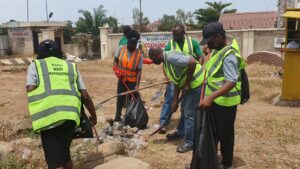
The agency made the call during a community clean-up and environmental sensitisation exercise organised by Digital Peers International (DPI) under its DPI-SGP 2.0 Project at Masaka Area 1 Roundabout in Karu Local Government Area of Nasarawa State.
Speaking on behalf of the director-general of NASWAMSA, Hon. Mohammed Bello Isa, the director of waste management, Dr. Ishaq Abubakar Ibrahim, said environmental cleanliness is directly linked to public health, safety and sustainable community development.
He warned that indiscriminate waste disposal continues to fuel flooding, environmental degradation, air and water pollution, and the spread of preventable diseases across communities.
“Every improperly disposed waste item has the potential to become a source of disease, environmental nuisance and economic loss. Environmental sanitation is a shared responsibility that requires the commitment of government, communities and individuals,” he said.
Dr. Ibrahim commended Digital Peers International for complementing government efforts through community engagement and environmental awareness campaigns, noting that the state government remains committed to building cleaner and healthier communities through improved waste collection systems, sanitation programmes, recycling initiatives and public enlightenment.
He urged residents to embrace waste reduction, segregation, recycling and responsible disposal practices, stressing that lasting environmental change can only be achieved through collective action.
“To those of us in the waste management sector, waste is not waste. What one person throws away can become another person’s source of income. That is why we promote the concept of waste-to-wealth,” he said.
He explained that about 65 per cent of waste generated in Nasarawa State is organic and can be converted into manure, thereby reducing farmers’ dependence on costly fertilisers while improving agricultural productivity.
He also highlighted the growing economic potential of plastic recycling, saying investments in the sector could generate jobs, support entrepreneurship and help address major environmental challenges in the state.
“Waste management is too important to be left to government alone. We welcome partnerships that can help unlock the economic value in waste while protecting the environment,” he added.
Speaking on behalf of the Chief Executive Officer of Digital Peers International (DPI), Dr. Mrs. Ibukun Odusote, Programme Officer Pada Zadunya said the organisation remains committed to ensuring that the initiative delivers lasting impact beyond project funding cycles.
“As an organisation, Digital Peers International (DPI) remains fully committed to ensuring that this initiative delivers lasting impact beyond the project funding cycle. We are determined to continue fostering strategic partnerships, supporting practical innovations, strengthening youth participation, and promoting sustainable environmental practices capable of transforming our communities for the better,” he said.
Zadunya stressed that environmental responsibility is a collective duty, calling on residents to sustain engagement beyond the exercise.
“Cleaner and healthier communities can only be achieved through collective action, commitment, and consistency from all stakeholders. We therefore encourage every participant here today to actively engage in this exercise and continue to serve as ambassadors of environmental sustainability within your homes, schools, workplaces, and communities,” he said.
In his remarks, the director of public health at NASWAMSA, Dr. Joseph David Anzaku, described the sensitisation exercise as a timely intervention that supports government efforts to promote environmental sanitation and disease prevention.
He warned that poorly managed waste creates breeding grounds for disease vectors, exposing communities to communicable and tropical diseases.
Participants took part in a clean-up campaign across parts of Masaka while also educating residents on proper waste disposal, recycling opportunities and environmental stewardship.
Stakeholders at the event agreed that sustained public awareness, youth participation and stronger investment in recycling infrastructure are essential to achieving cleaner, healthier and more resilient communities across Nasarawa State.