By Peter Egwuatu
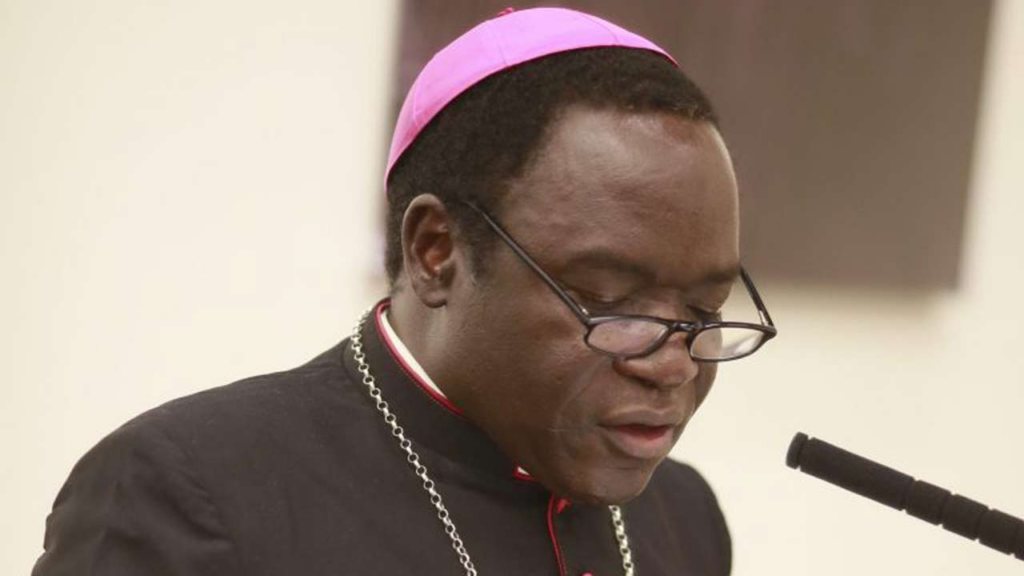
Bishop of Sokoto Catholic Diocese, Matthew Kukah, has challenged Nigerians to rethink their understanding of leadership, arguing that leadership should not be confused with political office or position.
According to him, many of Nigeria’s problems stem from the tendency to equate leadership with power rather than influence and service.
Delivering a keynote lecture on Monday in Lagos to commemorate the fifth anniversary of Pastor Emily Aig-Imoukhuede, Kukah expanded the conversation beyond remembrance to a broader examination of leadership and nation-building.
He said, “Leadership is not office. You can occupy an office without being a leader, and you can lead without holding any office. Leadership is influence. Leadership is responsibility.”
The cleric stressed that leadership must always be judged by whom it serves and the extent to which it promotes the common good. Quoting the utilitarian philosopher Jeremy Bentham, Kukah argued that governance and leadership should seek “the greatest happiness for the greatest number.”
He warned against a culture where public office becomes a vehicle for personal gain rather than service to society.
Drawing examples from history, religion and global politics, Kukah maintained that strong institutions and sustainable national development are built on moral foundations, values and character.
He lamented what he described as the erosion of ethical values in public life and called for a return to integrity, accountability and compassion.
The bishop further noted that Pastor Emily’s life represented a model of servant leadership rooted in faith, humility and concern for others.
“Leadership is about vision, values and character,” he said. “Character is what you do when nobody is watching.”
The event brought together an impressive array of dignitaries, including Fola Adeola, co-founder of GTBank; Sam Amuka-Pemu, publisher of Vanguard Newspapers; Nduka Obaigbena, publisher of THISDAY Newspapers; Chief Mike Oghiadomhe; Jim Ovia; Uzoma Dozie; Mr and Mrs Roosevelt Ogbonna; Temi Popoola, Group Managing Director of NGX Group; Tunde Fowler; and members of the Aig-Imoukhuede family, among others.
The gathering was not merely a remembrance of a remarkable woman; it was a profound reflection on leadership, service, faith, family and nation-building, the values that defined Pastor Emily’s life.
Meanwhile, in his welcome remarks, Chairman of Access Holdings Plc, Aigboje Aig-Imoukhuede, paid an emotional tribute to his mother, describing her as a woman whose life was guided by purpose and responsibility.
According to him, Pastor Emily believed that every opportunity carried an obligation and every blessing imposed a duty to bless others. He said she lived her life answering four important calls: the call to serve God, the call to serve family, the call to serve country, and the call to serve humanity.
“She believed that life was not meant to be lived for oneself alone,” he said. “Every gift carried responsibility. Every opportunity carried an obligation. Every blessing carried a duty to bless others.”
He recalled that even in her later years, she remained deeply concerned about Nigeria and constantly prayed for the country’s progress. Despite the challenges confronting the nation, she remained hopeful that Nigeria’s best days were still ahead.
Reflecting on the values she passed on to her children, Aig-Imoukhuede said the greatest inheritance from their parents was not material wealth but an enduring example of service, integrity and purposeful living.
“It was an example that taught us that success without service is ultimately empty, that influence without purpose is wasted, and that the true measure of life is not what we accumulate but what we contribute,” he said.
The keynote lecture delivered by Kukah expanded the conversation beyond remembrance to a broader examination of leadership and nation-building.
Kukah challenged Nigerians to rethink their understanding of leadership, arguing that leadership should not be confused with political office or position.
According to him, many of Nigeria’s problems stem from the tendency to equate leadership with power rather than influence and service.
“Leadership is not office,” he said. “You can occupy an office without being a leader, and you can lead without holding any office. Leadership is influence. Leadership is responsibility.”
The cleric stressed that leadership must always be judged by whom it serves and the extent to which it promotes the common good. Quoting the utilitarian philosopher Jeremy Bentham, Kukah argued that governance and leadership should seek “the greatest happiness for the greatest number.”
He warned against a culture where public office becomes a vehicle for personal gain rather than service to society.
Drawing examples from history, religion and global politics, Kukah maintained that strong institutions and sustainable national development are built on moral foundations, values and character.
He lamented what he described as the erosion of ethical values in public life and called for a return to integrity, accountability and compassion.
The bishop further noted that Pastor Emily’s life represented a model of servant leadership rooted in faith, humility and concern for others.
“Leadership is about vision, values and character,” he said. “Character is what you do when nobody is watching.”
The event also featured a panel discussion moderated by Fola Adeola, who framed the conversation around the four themes that shaped Pastor Emily’s life: service to God, service to family, service to nation and leadership.
Adeola argued that these were not separate spheres but interconnected dimensions of a single life of service.
“They are not four worlds,” he said. “They are one house. The thread that runs through every room and holds the whole house together is service.”
According to him, leadership, properly understood, is not the privilege of being served but the responsibility and joy of serving others.
The panel brought together accomplished women leaders, including Head of the Civil Service of the Federation, Mrs Didi Esther Walson-Jack, and leading corporate lawyer, Mrs Zelda Akindele.
The discussion explored the realities of balancing faith, family responsibilities, professional obligations and public service.
Walson-Jack shared a deeply personal story about choosing public service over personal convenience when she left her husband and young children behind to take up an assignment in Bayelsa State following the state’s creation.
The decision, she recalled, was painful but necessary because she believed she had a duty to contribute meaningfully to the development of the new state.
“It was then that I began to understand that leadership means service,” she said.
Reflecting on the values that have guided her career, Walson-Jack highlighted hard work, integrity, diligence and empathy as the pillars of her leadership philosophy.
She explained that these values were instilled in her by her father, who taught accountability and transparency through simple lessons at home.
For her, genuine leadership must ultimately help, empower, accept and love people.
Mrs Akindele spoke candidly about the challenges of balancing family life with professional leadership.
She noted that modern leadership often involves navigating competing demands from work, family and society, adding that true balance is a daily struggle rather than a permanent achievement.
“There is no world in which anyone has everything all of the time,” she said. “Every day involves choices and priorities.”
She observed that today’s leaders operate under intense public scrutiny, particularly in the age of social media, where personal and professional lives are constantly on display.
Despite these pressures, she stressed the importance of authenticity and remaining true to one’s values.
One of the most compelling themes to emerge from the discussions was the idea that service begins at home and extends outward to society.
The speakers repeatedly emphasised that family is the first training ground for leadership and that national transformation cannot occur without strong moral foundations at the family level.
As the evening drew to a close, participants reflected not only on the life of Pastor Emily Aig-Imoukhuede but also on the enduring relevance of the principles she embodied.
Her legacy, speakers agreed, was not measured by titles or status but by a lifetime of service to God, family, community and nation.
The memorial lecture succeeded in transforming remembrance into reflection and reflection into a call to action.